Main

March 27, 2008

Breaking the Rules: Suspicious bank transaction rules led to Spitzer resignation

Business rules triggered by Eliot Spitzer's suspicious money transfers led to his resignation as Governor of New York..

Spitzer broke these rules

The Justice Department says Spitzer is likely to be charged with a relativley obscure statute or rule called "structuring". Even people who know the rules break the rules. It all started a few months ago when a bank in New York followed the rules for filing a Suspicious Activity Report. It ended with his resignation last week.

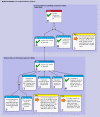
To help understand the rules that "fired" Spitzer, we created an interactive business rule model of SAR rules. The rules are on www.RuleMap.com. This is a new website we created for demonstrating our interactive BIZRULES® RuleMap™ rulebooks and business rule models.

A picture is worth a thousand words. We beleive this RuleMap makes it easy to understand the rules that Spitzer broke.

March 16, 2007

Best Buy, Bogus Prices: Confusion about pricing rules reveals need for business rules management

If employees don’t know, don’t understand, or don’t care what the rules are, you have a business rules problem.

If customers get different answers depending on who they talk to, you have a business rules problem.

If salespeople can decide whether to charge the right price or a bogus price, you have a business rules problem.

Best Buy, the nation's largest electronics retailer, has a business rules problem.

It's also dealing with a public relations nightmare, and an investigation by the Connecticut Attorney General's Office.

Pricing rules used by salespeople in Best Buy stores are inconsistent and contrary to Best Buy pricing policies established in the boardroom. “What we've learned very quickly is we have not been clear enough in communicating to our employees the policy, and how to execute it in our stores,” said Dawn Bryant, spokeswoman for Best Buy.

Success in the world of business depends on understanding the rules,” I said recently during a panel discussion on Sarbanes-Oxley compliance.

“You need to know the internal rules and policies of your business. You have to comply with the external rules and regulations that govern your business, industry, and function. Your company must ensure that rules are followed. Your company must enforce the rules. Your company must give staff tools to help them follow the rules, make legal decisions, and prevent them from making illegal decisions. Business rule management systems (BRMS) and business rule engines (BRE) help companies comply with rules and regulations like SOX.

If you don’t have a rule engine that automatically prevents employees from breaking the rules and instantly detects and prevents fraud, you’re out of the game. You’ll end up watching your stock go from $30 to $3 during lunch. You lose. You’re out of business.

Smart companies are using business rules to ensure compliance with rules, to enforce rules, to increase agility so they can change faster, to prevent business mistakes, and to reduce IT system development costs by changing rules in days not months.

Business rules technology helps business comply with rules and regulations, helps employees follow the rules, and prevents employees from breaking the rules (either accidentally or on purpose).”

Business rules management is the prescription for business rules problems. Business rules management entails everything from the business rules approach to business rules technology. 

The business rules approach helps companies transform complex policies into easy to understand business rules. What better way is there to clearly describe and communicate policies and business rules to employees?

Business rules technology helps companies execute the right business rules at the right time every time. What better technology is there to automate business rules?

What happened at Best Buy is a great example of what can go wrong when business rules are not designed and engineered properly.

Business rules are like the glue that holds together all the parts of the corporation. Business rules integrate and align all the moving parts of the corporation. With business rules management, Best Buy can ensure that rules and processes used in the stores are aligned with Best Buy pricing policies defined in the boardroom.

Without business rules management to connect the elements of the corporation, the only way to ensure the corporation works as intended is to "hope and pray," as John Zachman likes to say. With weak or wrong business rules, the corporation falls down like a house of cards.

This is why business rules management is vital to the corporation.

Business rules management is not just about documenting business rules, defining who the owners are, and deciding who is authorized to change them. It’s not just about using rule-based languages to speed up system development instead of hard-wiring rules in legacy code. It’s not just about selecting a business rules engine. It’s not just about understanding the company’s strategies, policies and business practices, and then transforming those objectives into rulebooks, descriptive business rule models, IT specifications, and finally into automated systems.

Business rules management is also concerned with architecting and engineering the business rules so they are integrated with the rest of the business. This helps ensure that the implemented business rules that are in actual use, whether automated or manual, align with the governing rules and strategies of the business.

What happened at Best Buy?

At first, I thought the Best Buy pricing problem was complicated and hard to explain. Then I wondered how can business rules help solve this problem? What would BIZRULES do if Best Buy came to us for help?

That’s easy. I like to draw pictures to simplify complex ideas. By removing the complexity, pictures help me make even the most complex concepts easy to understand:

BIZRULES Analysis of Best Buy Pricing Rules 

(Click to see medium or large slide)

This is an example of three business rules that were apparently in operation at Best Buy when this story broke. Of course, we really don't know the rules were, so this is just a good guess based on published news accounts of what really happened.

Along with a picture of the rules, this slide shows how the rules affect the rest of the company. It also shows how the rules satisfy business rules management objectives, and business rule engineering design objectives:

Rule #1 is a conceptual explanation of the pricing policy to honor the lowest price.

  • This rule tells us what management means and what their intentions are.

Rule #2 is a logical description of the corporate policy to honor the lowest price:

  • This business rule clearly shows alignment to corporate strategy.

  • This is the high quality rule prescribed by the pricing strategy.

  • This rule shows integration between online and retail stores.

  • This rule offers reusability – the same rule can be implemented online and in the store.

  • This rule shows transparency.

  • This rule reduces operations costs because it’s easy to follow.

  • This rule demonstrates regulatory compliance.

  • This picture is worth a thousand words.

  • This rule builds Customer Trust Management.

  • This is a “Best Buy” type of rule.

  • This rule is easy to approve, assess, test, and certify.

  • This rule improves governance and controllership.

Rule #3 is used (i.e. prescribed) by some salesman to mislead customers into paying higher prices:

  • This business rule is clearly not aligned to corporate strategy.

  • This poor quality rule is operational and being used in stores.

  • This rule shows discontinuity and inconsistency between online and retail stores.

  • This store rule cannot be reused online because it lacks transparency.

  • This rule increases operations costs because it’s hard to explain and justify.

  • This rule raises questions about regulatory compliance.

  • You need a thousand words to explain this picture.

  • This rule destroys customer confidence and trust.

  • This rule is public relations nightmare.

  • This rule may be illegal.

  • This is a “bait & switch” type of rule.

  • This rule should never have been approved.

  • This rule raises questions about whether proper rules, processes, and controls are in place.


Now that I understand what the current pricing situation at Best Buy is, it seems pretty straightforward:

  • Management intention is Rule #1. This is Best Buy’s pricing policy.
  • Marketing description is Rule #2. This is what marketing thinks is happening.
  • Sales prescription is Rule #3. This is what salespeople are actually doing.
  • IT specification is not applicable in this example because these rules have not been automated. If these rules were automated, an executable specification of the rule (i.e. pseudo code) may need to be developed for the programmer.


These four views of the business rules fit nicely into an Enterprise Rules Architecture.

The next step is to fit these rules into an enterprise architecture framework. I used John Zachman’s influential and compelling Framework for Enterprise Architecture as an example:

The Zachman Framework for Enterprise Architecture

(Click to see medium or large slide)

Next, I overlaid Best Buy Rules #1-3 on top of Zachman’s Enterprise Architecture Framework to add more clarity to the Best Buy pricing situation:

BIZRULES Analysis of Best Buy Pricing Rules (part 2)

 (Click to see medium or large slide)

The pricing problem at Best Buy is that the business rule used by salespeople in the stores contradicts the company’s pricing policy. Clearly Rule #3 is not aligned with Rule #1 or Rule #2.
Business rules confusion is what caused the problem.

Business rules management is the solution.

To get out of this sticky mess, Best Buy needs to:
  • establish or improve their business rules management.
  • prevent salespeople from using Rule #3 immediately
  • mandate use of Rule #2 immediately.
  • automate Rule #2 as soon as possible. Why let salespeople decide pricing at all? Let the computer figure out what the lowest price is.
  • use a business rule engine to automate this rule as quickly as possible. This rule change needs to happen overnight. But changing hard-wired rules in code takes take days or weeks. Often, companies that don’t use rule engines take months to change business rules as simple as these. This is one reason why companies buy rule engines: Changing rules in a rule engine takes minutes.
  • educate salespeople on the pricing rules. Of course, if Best Buy automated the rules using a rule engine, they wouldn’t need to train as much.
  • ensure compliance with these rules from now on.
What about the secret website?

Business rules can also help Best Buy get rid of the secret and duplicate website. It's hard enough to maintain and manage prices for thousands of products on one website, let alone two. There are costs associated with maintaining a duplicate site containing 250,000 pages; surely management and shareholders want to reduce redundant costs like these. One way is to use a business rule engine to eliminate the duplicate site and duplicate effort. Why not write a few rules to show different prices (if that really is management’s objective) depending on whether the salesman pulls up the web pages on the Internet or the "secret website" on the Intranet?

How else can business rules management and business rules technology help Best Buy? Please comment and let me know.

Rolando Hernandez

CEO & Chief Rules Architect, BIZRULES


1 1 1

1
1
1
1

Continue reading "Best Buy, Bogus Prices: Confusion about pricing rules reveals need for business rules management" »

Best Buy + Secret Website = State Investigation of Best Buy Sales Rules

Best Buy uses a “secret website” in their stores to mislead customers and deny them discounts advertised on BestBuy.com  

On February 9, 2007 George Gombossy, Staff Writer/Consumer Watchdog reporter for The Hartford Courant, wrote this article on how Best Buy salesmen in the West Hartford, CT, and  Newington, CT, stores refused to honor $150 discounts offered on a Toshiba laptop advertised on Best Buy's public website - bestbuy.com.

The salesmen justified their refusal by showing the customer a secret website that appeared to be BestBuy.com. This secret website that they accessed in the store did not have the sales price.

Best Buy spokesman Justin Barber called the reporter back and said Best Buy's policy is to always honor the lowest advertised price, whether from its Internet site or from a competitor.  Barber insisted that "nothing improper was going on and that there was no secret website that virtually duplicates the public site so salesmen can dupe customers."

On February 10, 2007 the Connecticut Attorney General's office started an investigation into whether Best Buy maintains a secret intranet site that may have been used by some salesmen to deny customers discounts that appear on the company's public Internet site. The AG's office office informed Best Buy that he wants answers about its Internet policies and to disclose whether it has an intranet site that could be used to mislead customers. His office will also look into whether other chain stores may be using similar sales practices.

"The key question is whether consumers were advertised one price, and then denied that price when they got to the store," Connecticut Attorney General Richard Blumenthal said last week.  Under pressure from state investigators, Best Buy later confirmed that its stores indeed do have a "secret intranet site that has been used to block some consumers from getting cheaper prices advertised on BestBuy.com."

What happened at Best Buy is a great example of what can go wrong when business rules and processes are not managed properly. At a minimum, this is clearly an example of poor business rules management practices and poor process management practices. At a maximum, executives, employees and the company could be liable for damages.

This situation shows why business rules management is vital to the corporation.

See: Best Buy, Bogus Prices: Confusion about pricing rules reveals need for business rules management

1
1

Continue reading "Best Buy + Secret Website = State Investigation of Best Buy Sales Rules" »

March 14, 2007

New Power for Management: Business Rules

Understanding and managing business rules is vital to the corporation. It is just as important as managing people, processes, and information.

Nevertheless, business rules are often misunderstood and poorly managed.

Many rules remain unwritten – they are known only to and retained by subject matter experts who sooner or later leave the corporation, causing brain drain. When business rules are written, they are seldom shared and reused throughout the corporation, which increases operating costs. When business rules are automated, they may not be aligned to the business strategies and policies, leading to quality problems.

In order to program business rules, programmers often rely on unclear business rule specifications that are incomplete or incorrect. Then they usually hard-wire the business rules in computer languages that only programmers can understand and change.

Because programmers are not directly involved in the day-to-day operation of the business, they often make assumptions about what the rules are and what management intended. That leads to mistakes or bugs in the programs, which requires further programming and re-programming.

There is a solution.

Some corporations use advanced business rules technology and business rule management methods to take business rules out of IT and bring them back into the business. Now management can finally manage and change their business rules.

Business rules management techniques help management clearly describe and communicate business rules to employees, partners, and customers. Business rule management software helps automate the rules that should be rule-based.

Business rules improve the condition of the corporation. They prevent business mistakes and minimize risk. They solve many critical problems facing business and IT.

Business rules are like the glue that holds together all the parts of the corporation, ensuring that the automated rules align with goals and strategies.

Business rules integrate and align all the moving parts of the corporation into a cohesive enterprise architecture and operating system that works, changes, and lasts.

Business rules give new power to management.

1 1

Continue reading "New Power for Management: Business Rules" »

October 17, 2006

$6 Billion Business Mistake at Airbus caused by Poor Process Mgmt

I like to tell executives that business rule engines help prevent business mistakes. As a matter of fact, I am extremely confident that preventing business mistakes provides enough ROI on its own to justify the investment in business rules management and technology.

So one of my favorite sections in the Business Rules Knowledge Base is where I tell you about real life examples of business mistakes caused by poor rules management, poor process management, and poor knowledge management.
I've just added an entry on a business process mistake that led to a $6 billion profit hit at Airbus. Very interesting reading, at least to me...

Wayward Airbus - Cross-border clashes have led to costly production errors. Job One for a new CEO will be to unify the jetmaker. "Airbus' A380 double-decker jet is two years behind schedule, sending billions of dollars in potential profits down the drain. But the reason sounds too simple to be true: Airbus factories in Germany and France were using incompatible design software, so the wiring produced in Hamburg didn't fit properly into the plane on the assembly line in Toulouse. It's one of the costliest blunders in the history of commercial aviation, and it has plunged Airbus into crisis. Chief Executive Christian Streiff quit on Oct. 9 after only three months on the job...

The delays in the A380 mean EADS will take a $6 billion profit hit over the next four years...

When bundles of the cabin wiring started arriving in Toulouse early this year, assembly slowed to a crawl. Workers tried to make them fit into the fuselage by pulling them apart and rethreading the wires, but that proved to be impractical, and the effort was abandoned. Airbus says it has introduced new software to correct the wiring design, but it will take months for engineers to get up to speed on the new system. That's why Airbus now predicts it won't deliver the first A380 orders until late 2007... BusinessWeek, Oct. 23, 2006

Source: http://www.businessweek.com/magazine/content/06_43/b4006075.htm b4006075.htm
Locations of visitors to this page