Main

March 27, 2008

Breaking the Rules: Suspicious bank transaction rules led to Spitzer resignation

Business rules triggered by Eliot Spitzer's suspicious money transfers led to his resignation as Governor of New York..

Spitzer broke these rules

The Justice Department says Spitzer is likely to be charged with a relativley obscure statute or rule called "structuring". Even people who know the rules break the rules. It all started a few months ago when a bank in New York followed the rules for filing a Suspicious Activity Report. It ended with his resignation last week.

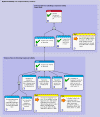
To help understand the rules that "fired" Spitzer, we created an interactive business rule model of SAR rules. The rules are on www.RuleMap.com. This is a new website we created for demonstrating our interactive BIZRULES® RuleMap™ rulebooks and business rule models.

A picture is worth a thousand words. We beleive this RuleMap makes it easy to understand the rules that Spitzer broke.

March 13, 2008

Visible Knowledge LLC helps companies prevent Brain Drain

10,000 baby boomers are retiring today.

10,000 more will retire next Monday. And Tuesday. And so on. That's the way it's going to be for the next 20 years. Key personnel and subject matter experts with 20 to 30 years of experience are going to clear their desk and head down to Florida. As they walk out the door, invaluable corporate knowledge will simply disappear.

Intellectual capital, a vital corporate asset, will melt away unless companies do something to stop the brain drain and to retain critical knowledge.

Visible Knowledge LLC (www.visibleknowledge.com) has a solution:

  • An interactive RuleMap™ that models business rules & simulates business logic
  • An interactive Expertise Blueprint™ that transforms knowledge into Visible Knowledge™
  • A Legacy Interview(sm) 

Visible Knowledge helps companies retain vital corporate knowledge before it melts away. They focus on documenting invaluable critical knowledge from your top domain experts and key personnel, before they retire. It can take companies years and millions of dollars to recover from losing this type of knowledge.

A traditional exit interview is just not enough when you're dealing with subject matter experts or super experts. So Visible Knowledge has developed a Legacy Interview(sm) process that extracts and documents critical knowledge before experts leave or retire. They use a rapid knowledge acquisition process to extract maximum amount of knowledge in a minimum amount of time. Visible Knowledge focuses on capturing critical knowledge.

If Know It All Ken just gave you two weeks notice, and he's the only one who knows how to fix the $5 million widget making machine, Visible Knowledge can help. They can spend a few days with Ken and document the crucial knowledge you need to keep the business running.  

If Super Expert Sally is retiring in a few months, Visible Knowledge can spend a few weeks with her to elicit as much vital and critical knowledge as possible before she leaves.

If your entire Dept of Super Experts is retiring next year, Visible Knowledge can work with your team over the next few months or years to document the critical knowledge you need to retain.

Later, if you need to automate the knowledge that was captured and retained, companies like BIZRULES can help you do that. BIZRULES works with leading knowledge software vendors to design and build knowledge-based and rule-based solutions.

November 14, 2007

Haley Rule Bursts into the business rules market

Business Rules Management and Business Rule Engines at a tipping point

Haley Rules was acquired yesterday by RuleBurst. Previously, RuleBurst seemed to position itself as an up-front rule modeling tool or rule management tool, especially for government applications, that integrated with the Microsoft Business Rule Engine for rule execution. With this acquisition, RuleBurst acquires one of the fastest rule engines on the block. Now they don't need the MSFT rules engine because they have their own! And instead of taking a few more years to build a stronger presence in the U.S., they established a strong presence in the US market overnight.

RuleBurst is a natural fit for legislative rules. As a matter of fact, they used to market their tool as Legislative Rulebase Technology years ago, when the company was called SoftLaw. They talked about the idea of Electronic Legislation. E-Government is a great niche, because government is good business.

Now it seems clear that RuleBurst is ready to go after the corporate / private-sector market just as hard. Ruleburst is very serious and methodical. They plan ahead strategies like international expansion (done), government rules market leadership (done - can you spell I R S?), and long-term expansion into the corporate rules market as well (well underway with Haley acquisition).

Adding the Haley Rules Engine could improve performance for deployment. Not sure what they would do with Haley Authority - that is very impressive natural language technology that is like nothing else on the market. There's a good reason Haley is based in Sewickley, PA: Carnegie Mellon University and A.I. expertise. Softlaw was one of the first companies to get into the rules market, and they are among the few who are still around today (under the name RuleBurst of course).

The new BRE Family Tree 2008 (as of yesterday) shows a quick summary of that history:BRE Family Tree 2008

Here's the official press release about the acquisition.

Here's the rest of the story:

In September 2001 I met with a SoftLaw executive (not sure if he was CEO at the time or if he became their CEO later) in Orlando, FL to brief him on the U.S. rules market and advise them on their expansion plans and strategies. We talked about challenges faced by government agencies such as the IRS, and their search for business rule engines and business rules management solutions. At that time I was working for IBM on the IRS Modernization project. Back then the IRS was looking at CA AION, Sapiens, etc. It took a few years, but SoftLaw (RuleBurst) finally broke through and is now one of the tools used on the IRS project.

During those meetings we also talked about marketing opportunities in the US. I told them about the Business Rules Forum and other rules conferences that they should attend and exhibit at. They started attending, and are now regular exhibitors.

This year at the Business Rules Forum it was a little odd that Haley Software did not have a booth. Now we know why.


March 16, 2007

Best Buy, Bogus Prices: Confusion about pricing rules reveals need for business rules management

If employees don’t know, don’t understand, or don’t care what the rules are, you have a business rules problem.

If customers get different answers depending on who they talk to, you have a business rules problem.

If salespeople can decide whether to charge the right price or a bogus price, you have a business rules problem.

Best Buy, the nation's largest electronics retailer, has a business rules problem.

It's also dealing with a public relations nightmare, and an investigation by the Connecticut Attorney General's Office.

Pricing rules used by salespeople in Best Buy stores are inconsistent and contrary to Best Buy pricing policies established in the boardroom. “What we've learned very quickly is we have not been clear enough in communicating to our employees the policy, and how to execute it in our stores,” said Dawn Bryant, spokeswoman for Best Buy.

Success in the world of business depends on understanding the rules,” I said recently during a panel discussion on Sarbanes-Oxley compliance.

“You need to know the internal rules and policies of your business. You have to comply with the external rules and regulations that govern your business, industry, and function. Your company must ensure that rules are followed. Your company must enforce the rules. Your company must give staff tools to help them follow the rules, make legal decisions, and prevent them from making illegal decisions. Business rule management systems (BRMS) and business rule engines (BRE) help companies comply with rules and regulations like SOX.

If you don’t have a rule engine that automatically prevents employees from breaking the rules and instantly detects and prevents fraud, you’re out of the game. You’ll end up watching your stock go from $30 to $3 during lunch. You lose. You’re out of business.

Smart companies are using business rules to ensure compliance with rules, to enforce rules, to increase agility so they can change faster, to prevent business mistakes, and to reduce IT system development costs by changing rules in days not months.

Business rules technology helps business comply with rules and regulations, helps employees follow the rules, and prevents employees from breaking the rules (either accidentally or on purpose).”

Business rules management is the prescription for business rules problems. Business rules management entails everything from the business rules approach to business rules technology. 

The business rules approach helps companies transform complex policies into easy to understand business rules. What better way is there to clearly describe and communicate policies and business rules to employees?

Business rules technology helps companies execute the right business rules at the right time every time. What better technology is there to automate business rules?

What happened at Best Buy is a great example of what can go wrong when business rules are not designed and engineered properly.

Business rules are like the glue that holds together all the parts of the corporation. Business rules integrate and align all the moving parts of the corporation. With business rules management, Best Buy can ensure that rules and processes used in the stores are aligned with Best Buy pricing policies defined in the boardroom.

Without business rules management to connect the elements of the corporation, the only way to ensure the corporation works as intended is to "hope and pray," as John Zachman likes to say. With weak or wrong business rules, the corporation falls down like a house of cards.

This is why business rules management is vital to the corporation.

Business rules management is not just about documenting business rules, defining who the owners are, and deciding who is authorized to change them. It’s not just about using rule-based languages to speed up system development instead of hard-wiring rules in legacy code. It’s not just about selecting a business rules engine. It’s not just about understanding the company’s strategies, policies and business practices, and then transforming those objectives into rulebooks, descriptive business rule models, IT specifications, and finally into automated systems.

Business rules management is also concerned with architecting and engineering the business rules so they are integrated with the rest of the business. This helps ensure that the implemented business rules that are in actual use, whether automated or manual, align with the governing rules and strategies of the business.

What happened at Best Buy?

At first, I thought the Best Buy pricing problem was complicated and hard to explain. Then I wondered how can business rules help solve this problem? What would BIZRULES do if Best Buy came to us for help?

That’s easy. I like to draw pictures to simplify complex ideas. By removing the complexity, pictures help me make even the most complex concepts easy to understand:

BIZRULES Analysis of Best Buy Pricing Rules 

(Click to see medium or large slide)

This is an example of three business rules that were apparently in operation at Best Buy when this story broke. Of course, we really don't know the rules were, so this is just a good guess based on published news accounts of what really happened.

Along with a picture of the rules, this slide shows how the rules affect the rest of the company. It also shows how the rules satisfy business rules management objectives, and business rule engineering design objectives:

Rule #1 is a conceptual explanation of the pricing policy to honor the lowest price.

  • This rule tells us what management means and what their intentions are.

Rule #2 is a logical description of the corporate policy to honor the lowest price:

  • This business rule clearly shows alignment to corporate strategy.

  • This is the high quality rule prescribed by the pricing strategy.

  • This rule shows integration between online and retail stores.

  • This rule offers reusability – the same rule can be implemented online and in the store.

  • This rule shows transparency.

  • This rule reduces operations costs because it’s easy to follow.

  • This rule demonstrates regulatory compliance.

  • This picture is worth a thousand words.

  • This rule builds Customer Trust Management.

  • This is a “Best Buy” type of rule.

  • This rule is easy to approve, assess, test, and certify.

  • This rule improves governance and controllership.

Rule #3 is used (i.e. prescribed) by some salesman to mislead customers into paying higher prices:

  • This business rule is clearly not aligned to corporate strategy.

  • This poor quality rule is operational and being used in stores.

  • This rule shows discontinuity and inconsistency between online and retail stores.

  • This store rule cannot be reused online because it lacks transparency.

  • This rule increases operations costs because it’s hard to explain and justify.

  • This rule raises questions about regulatory compliance.

  • You need a thousand words to explain this picture.

  • This rule destroys customer confidence and trust.

  • This rule is public relations nightmare.

  • This rule may be illegal.

  • This is a “bait & switch” type of rule.

  • This rule should never have been approved.

  • This rule raises questions about whether proper rules, processes, and controls are in place.


Now that I understand what the current pricing situation at Best Buy is, it seems pretty straightforward:

  • Management intention is Rule #1. This is Best Buy’s pricing policy.
  • Marketing description is Rule #2. This is what marketing thinks is happening.
  • Sales prescription is Rule #3. This is what salespeople are actually doing.
  • IT specification is not applicable in this example because these rules have not been automated. If these rules were automated, an executable specification of the rule (i.e. pseudo code) may need to be developed for the programmer.


These four views of the business rules fit nicely into an Enterprise Rules Architecture.

The next step is to fit these rules into an enterprise architecture framework. I used John Zachman’s influential and compelling Framework for Enterprise Architecture as an example:

The Zachman Framework for Enterprise Architecture

(Click to see medium or large slide)

Next, I overlaid Best Buy Rules #1-3 on top of Zachman’s Enterprise Architecture Framework to add more clarity to the Best Buy pricing situation:

BIZRULES Analysis of Best Buy Pricing Rules (part 2)

 (Click to see medium or large slide)

The pricing problem at Best Buy is that the business rule used by salespeople in the stores contradicts the company’s pricing policy. Clearly Rule #3 is not aligned with Rule #1 or Rule #2.
Business rules confusion is what caused the problem.

Business rules management is the solution.

To get out of this sticky mess, Best Buy needs to:
  • establish or improve their business rules management.
  • prevent salespeople from using Rule #3 immediately
  • mandate use of Rule #2 immediately.
  • automate Rule #2 as soon as possible. Why let salespeople decide pricing at all? Let the computer figure out what the lowest price is.
  • use a business rule engine to automate this rule as quickly as possible. This rule change needs to happen overnight. But changing hard-wired rules in code takes take days or weeks. Often, companies that don’t use rule engines take months to change business rules as simple as these. This is one reason why companies buy rule engines: Changing rules in a rule engine takes minutes.
  • educate salespeople on the pricing rules. Of course, if Best Buy automated the rules using a rule engine, they wouldn’t need to train as much.
  • ensure compliance with these rules from now on.
What about the secret website?

Business rules can also help Best Buy get rid of the secret and duplicate website. It's hard enough to maintain and manage prices for thousands of products on one website, let alone two. There are costs associated with maintaining a duplicate site containing 250,000 pages; surely management and shareholders want to reduce redundant costs like these. One way is to use a business rule engine to eliminate the duplicate site and duplicate effort. Why not write a few rules to show different prices (if that really is management’s objective) depending on whether the salesman pulls up the web pages on the Internet or the "secret website" on the Intranet?

How else can business rules management and business rules technology help Best Buy? Please comment and let me know.

Rolando Hernandez

CEO & Chief Rules Architect, BIZRULES


1 1 1

1
1
1
1

Continue reading "Best Buy, Bogus Prices: Confusion about pricing rules reveals need for business rules management" »

Best Buy + Secret Website = State Investigation of Best Buy Sales Rules

Best Buy uses a “secret website” in their stores to mislead customers and deny them discounts advertised on BestBuy.com  

On February 9, 2007 George Gombossy, Staff Writer/Consumer Watchdog reporter for The Hartford Courant, wrote this article on how Best Buy salesmen in the West Hartford, CT, and  Newington, CT, stores refused to honor $150 discounts offered on a Toshiba laptop advertised on Best Buy's public website - bestbuy.com.

The salesmen justified their refusal by showing the customer a secret website that appeared to be BestBuy.com. This secret website that they accessed in the store did not have the sales price.

Best Buy spokesman Justin Barber called the reporter back and said Best Buy's policy is to always honor the lowest advertised price, whether from its Internet site or from a competitor.  Barber insisted that "nothing improper was going on and that there was no secret website that virtually duplicates the public site so salesmen can dupe customers."

On February 10, 2007 the Connecticut Attorney General's office started an investigation into whether Best Buy maintains a secret intranet site that may have been used by some salesmen to deny customers discounts that appear on the company's public Internet site. The AG's office office informed Best Buy that he wants answers about its Internet policies and to disclose whether it has an intranet site that could be used to mislead customers. His office will also look into whether other chain stores may be using similar sales practices.

"The key question is whether consumers were advertised one price, and then denied that price when they got to the store," Connecticut Attorney General Richard Blumenthal said last week.  Under pressure from state investigators, Best Buy later confirmed that its stores indeed do have a "secret intranet site that has been used to block some consumers from getting cheaper prices advertised on BestBuy.com."

What happened at Best Buy is a great example of what can go wrong when business rules and processes are not managed properly. At a minimum, this is clearly an example of poor business rules management practices and poor process management practices. At a maximum, executives, employees and the company could be liable for damages.

This situation shows why business rules management is vital to the corporation.

See: Best Buy, Bogus Prices: Confusion about pricing rules reveals need for business rules management

1
1

Continue reading "Best Buy + Secret Website = State Investigation of Best Buy Sales Rules" »

September 13, 2006

Knowledge Management is Key to Preventing Brain Drain. BP found out the hard way.

CEO’s finally got a wake up call about the true value of managing knowledge and the risks of losing intellectual capital. It is becoming painfully obvious that companies need to document and retain the knowledge of their key personnel and subject matter experts. They need to manage this intellectual capital and treat it like Intellectual Property (IP) before it simply walks out the door. Just ask British Petroleum. When BP senior corrosion engineer Richard C. Woollam left, BP lost valuable intellectual capital, namely his knowledge, experience, and expertise. That’s when the brain drain began.

Around February 25, 2006, corrosion in the Prudhoe Bay pipeline caused a “small leak” in a quarter-inch hole in the pipe. BP discovered the leak five days later on March 2, after 250,000 gallons of crude oil spilled across 1.93 acres. The spill, the largest ever on Alaska’s North Slope, forced BP to shut down the pipeline and the Prudhoe Bay oilfield, the largest U.S. oilfield. Overnight, 8% of domestic oil production was shut down due to “extensive corrosion”.


“By the time a massive oil-pipeline spill was discovered in March on Alaska's North Slope, the job of BP's senior corrosion engineer had been left unfilled for more than a year, an internal BP audit found. This vacancy, and others, hindered BP's ability to maintain a ‘strategic view’ of its corrosion prevention activities, the audit found. A BP spokesman said Friday that a replacement for the senior corrosion engineer has yet to be found...”

"Alaska Gov. Frank Murkowski and other officials toured the Prudhoe Bay oil pipelines, which have been crippled by corrosion problems discovered this week. The threat of a stoppage also endangers Alaska's budget: Oil taxes account for more than 90 percent of its revenues...

On August 7, oil spilled in the Eastern Operating Area of BP's Prudhoe Bay oil field.

“Half of Prudhoe Bay oil field's production operations were shutdown Aug. 7 in its Eastern Operating Area after a leak was detected and about 630 gallons of crude oil leaked. Downgraded operations closed 16 miles of oil transit lines and halted 400,000 barrels of oil production a day in the Alaskan oil field, reducing 8 percent of U.S. domestic production…"
On September 6, Congress began hearings on BP’s corrosion problems in Alaska.

“U.S. lawmakers are launching an investigation into the August shutdown of BP's Prudhoe Bay operations after corrosion was detected in the 29-year-old pipeline...”

The House Energy and Commerce Committee holds a hearing ON September 7 on BP's corrosion problems in Alaska. A leak forced the shutdown of half the Prudhoe Bay oil field. Committee Chairman Joe Barton says evidence indicates the problem was caused by BP's poor maintenance of the pipeline..."

It was "truly beyond comprehension" that a profitable company such as BP would fail to maintain the infrastructure that was the basis for its earnings – Rep. Jan Schakowsky, D-Ill.

"BP's top U.S. executives told lawmakers Thursday that the company stumbled by failing to prevent a major Alaskan pipeline from becoming crippled by corrosion..."

"At the hearing, a former BP official responsible for monitoring pipeline corrosion invoked the Fifth Amendment in response to the panel's questions about the problems that led to the partial shutdown of the nation's largest oilfield..."

"BP's operating failures are unacceptable. They have fallen short of what the American people expect of BP and they have fallen short of what we expect of ourselves." – BP America Chairman Bob Malone told members of a House panel.

"I deeply regret this situation occurring on my watch," – Steve Marshall, president of BP exploration in Alaska

Hearings continued on Capital Hill on September 13.

"BP didn't fundamentally understand the conditions of their lines and did not maintain it properly," Thomas Barrett, administrator for the Pipeline and Hazardous Materials Safety Administration, testified Tuesday before the Senate Energy committee.

Clearly, BP did not document nor retain the knowledge of its senior corrosion engineer. Every company should, at a minimum, document and retain the knowledge of key individuals and subject matter experts if it wants to have any hope of not wasting time and money reinventing the wheel every time smart people leave.

But shareholders deserve better. So smart companies not only capture and retain knowledge, they also digitize, automate, and manage that knowledge so it can be shared and leveraged throughout the enterprise. Just ask great companies like ExxonMobil.

In the early 1990’s, Mobil Oil developed a bold strategy to transform the knowledge of their top lubrication experts around the world into digital assets that could be shared throughout the Mobil system. This global expert system strategy and global knowledge management strategy led to development of the Mobil Lube Knowledge Base.

Mobil Marketing executives first started understanding the value of capturing knowledge as a corporate asset in 1989, after the rollout of the ALFRED Rolling Oils Expert System. This expert advisor captured 50 years of Mobil's experience with rolling oils and metal rolling mills. The knowledge was represented in the system as a collection of business rules and expert decisioning rules.

Mobil's Lube Marketing Strategy in the 1980's was to provide value added services to customers. Executives started envisioning a global "Lube Knowledge Base" as a laptop sales tool to support every sales engineer worldwide. LKB goals were to:

  • Capture expertise from top marketers & engineers and make it available worldwide
  • Train field reps
  • Improve customer service & service quality
  • Provide consistent solutions
  • Minimize paperwork/looking through thick manuals

By 1991, business and IT executives agreed there was a need to develop a worldwide lube expert systems strategy. The IT strategy was aligned with Mobil’s longstanding lube marketing strategy to provide value added services to customers. IT and the US / Intl’l business units planned a strategic Knowledge Management Program with these goals:

  • Maintain Mobil’s competitive edge in the worldwide lube market
  • Provide current product and customer data to the field sales force
  • Capture individual expertise and share that knowledge throughout the Mobil system
  • Enable marketers to increase face to face selling time

The Mobil Lube Knowledge Base consisted of a suite of interoperable and integrated expert advisors and knowledgebases that retained and shared Mobil’s best knowledge on everything from Environmental Health & Safety (EH&S), grease marketing, compressor lubrication troubleshooting, to rolling oil program diagnosis. Expert advisors were also envisioned for hydraulics, cutting oils, and marine (cruise ship) diesel engine lubrication. Knowledge engineers interviewed Mobil experts from the U.S., Japan, England, France, Germany, New Zealand, The Netherlands, Austria and other countries to elicit their knowledge and build the global Lube Knowledge Base.

One of the systems in the Knowledge Base was the EH&S audit expert advisor. Jim W. was Mobil’s EH&S audit expert. Jim was also an expert on fighting oil refinery fires and cleaning up oil spills. As Jim neared retirement, Mobil did not want to lose his 30+ years of intellectual capital conducting EH&S audits. One of the nicest and smartest persons you will ever meet, Jim was a
super expert who reported on a dotted line to the CEO. Knowledge engineers collaborated with Jim to build the expert advisor. “Cloning” Jim was Mobil’s answer to retaining his knowledge and expert advice.

The Lube Knowledge Base was a big success. IT and Marketing worked together to develop a business strategy and computer systems to support it. When the Grease Expert System was launched in 1993, it marked the first time Mobil released an IT system to support a major marketing strategy at the same time the global marketing strategy was launched. Previously, IT would learn about new business strategies after they were in effect.

Today, 15 years later, it’s possible that someone at ExxonMobil could run the EH&S Expert System, answer a few of Jim’s questions, and get Jim’s expert advice, recommendations, and explanations. Despite the fact that Jim retired years ago.

How valuable is that to a corporation? What is the value of retaining 30 years of top-level corporate knowledge? What is the cost of capturing knowledge? What is the price of not capturing knowledge and having to deal with brain drain? How could you put a price on that?

Well, lawyers tell me that that’s relatively easy. What’s really hard is extracting, capturing, and retaining knowledge from people like Jim at Mobil and BP’s senior corrosion engineer Richard C. Woollam. There are
methodologies, however, that take the pain out of the knowledge acquisition process and minimize the amount of time experts need to dedicate to the process.

Before today few companies really cared about knowledge management (KM) or made it a priority. Great companies, on the other hand, figured out long ago how to manage knowledge and treat it as Intellectual Property.

Now it's the law.

From now on if the knowledge of the corporation’s top experts and key personnel is lost, the company risks having to explain to shareholders, Congress, and regulators how that Intellectual Property was lost, why it was not retained, why it will cost $10 million and 5 years to regain that knowledge, and why the stock price went from $20 to $2 during lunch.

Companies better start asking themselves what is the risk if key people leave, get hit by a truck, or retire. What is the risk of not retaining the knowledge of top experts so it can be passed on to the next generation?

BP is paying the price for not managing knowledge. They need to steal a page from Mobil’s playbook and figure out how to manage knowledge to mitigate the risk of brain drain.

Icebergs can sink the Corporation Knowledge management requires eliciting, capturing, retaining, digitizing, automating and managing what your smartest people know. And then sharing it with those who need to know.

Imagine knowledge as an iceberg:

"Its tangible, visible part that can be accessed by third persons, i.e. information, can be observed 'above the water.' Once it has been shared, it belongs to everybody.

A large, important part of it, i.e. tacit knowledge is intangible, invisible, as if hidden “under the water” and can be accessed on the first-person basis only."

Knowledge management is really about transforming intangible tacit knowledge in people’s heads into tangible visible knowledge that can be shared.


Businesses often claim that their most valuable asset is their people. From now on, businesses are going to have to pay more than lip service to that idea. Now they need to elicit the tacit knowledge of their top people, transform it into digital intellectual capital or Intellectual Property (IP) assets, and value it on the books.

The cost of managing knowledge is much less than the risk of brain drain.

Just ask BP. 

Note: BIZRULES CEO Rolando Hernandez was  one of the lead designers of the Mobil Lube Knowledge Base.

References:

Analysis: Lax regulations cause BP spill - By DONNA BORAKUPI Energy Correspondent Sep 13 2006 Analysis: Congress probes BP corrosion - By DONNA BORAK UPI Energy Correspondent Sep 6, 2006 BP audit: Key job vacant before spill - By BRAD FOSS, AP Business Writer, Fri Sep 8, 2006 Congress Investigates Alaska BP Pipeline Leak - by Scott Horsley, NPR Morning Edition, Sep 7, 2006 A Diminished Supply of Oil - NPR Understanding Knowledge Societies In twenty questions and answers with the Index of Knowledge Societies, Department of Economic and Social Affairs Division for Public Administration and Development Management, United Nations, New York, 2005

July 05, 2006

Productivity of the Mind

In a recent issue of Chief Executive* magazine, Editor in Chief J.P. Donlon had this to say about the value of knowledge management:
The single greatest challenge facing CEOs is to raise the productivity of knowledge throughout the enterprise. It is an economic truth that real earnings and real incomes cannot be higher than productivity for any length of time. And knowledge and insight into customer behavior—as opposed to mere information—is the fuel that propels innovativeness.
Wow! I am glad to see an influential business magazine make the point that knowledge, not "mere" information, is the key to productivity, earnings, and incomes. This is exactly what CEOs need to know, and chances are they've read this*. I'm not sure I would say that managing knowledge and raising the productivity of knowledge is the single greatest challenge facing CEOs, but I would certainly say that it is among the top challenges CEOs face. I've been making a similar point for years, that:

Real and lasting competitive edge comes from managing knowledge, not just managing information.

I also like J.P. Donlon's analogy, but I'd like to take it one step further:

If knowledge is the fuel that propels innovativeness, then inference engines and rule engines are the engines that burn the fuel, automate the knowledge, and fire the rules that drive the business.

Rule engines/inference engines are the most effective and most efficient ways to automate knowledge and business rules. Is there any doubt left that every enterprise that wants to compete and innovate and win in today's knowledge-based economy needs a rule engine/inference engine?

*
About Chief Executive

Chief Executive
is the only magazine written strictly for CEOs and their peers. As the leading source of intelligence for and about CEOs, it provides ideas, strategies and tactics for top executive leaders seeking to build more effective organizations... The readers of Chief Executive include the world's most influential leaders - the CEOs of major corporations around the globe...
Locations of visitors to this page